Shopify development in Egypt
Shopify runs your inventory, payments and orders. We build the storefront that makes people buy — and come back for a second order.
Shopify is a good decision for a lot of brands here: it handles the parts you should not be building yourself, and it does not break at three in the morning. What it does not do is make your store look like yours, or make the checkout suit how Egyptians actually pay.
That is the part we build. A custom theme rather than a bought one, a product page that answers 'is this worth it?' before the doubt forms, and a checkout with the fields and the local payment methods your customers expect — because every step you remove recovers carts that were already abandoned.
What we build on Shopify
- Product pages that convince — photography, copy and layout answer 'is this worth it?' before the doubt forms.
- Checkout without friction — fewer fields, local payment methods, no forced accounts. Every removed step recovers abandoned carts.
- Built for the second order — saved details and reorder in a couple of taps. Profit lives in returning customers.
- A brand, not a template — a custom theme designed for you, so your store never looks like everyone else's.
Being straight about the proof
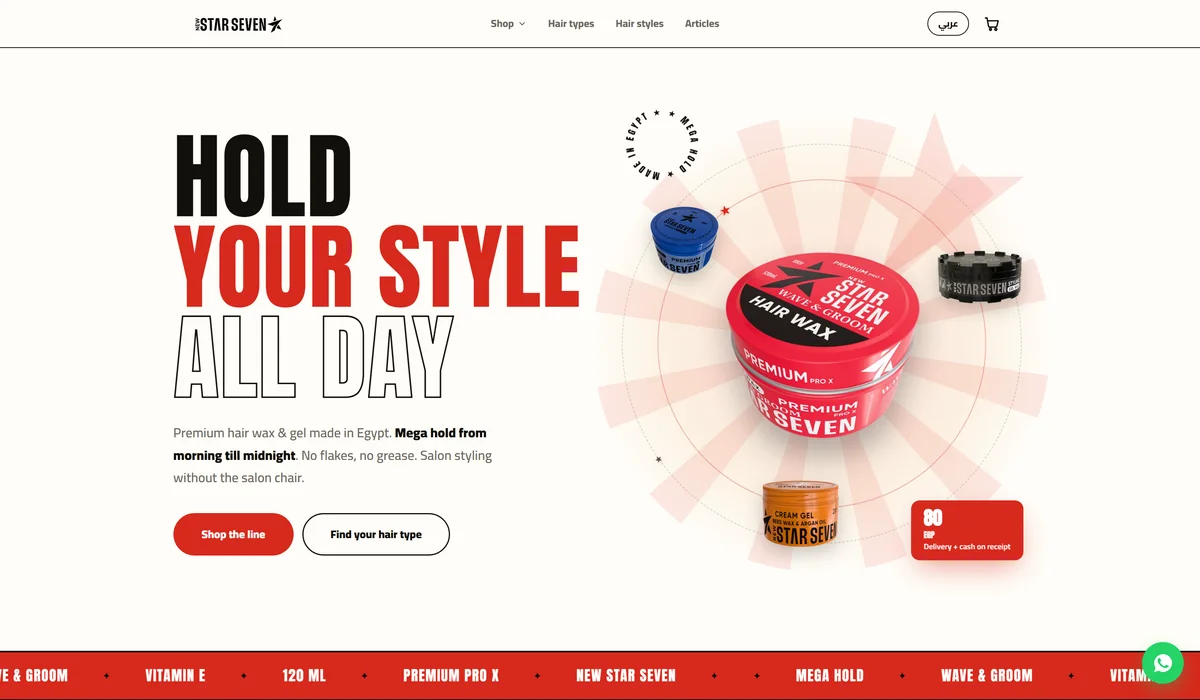
The stores below are custom builds rather than Shopify ones, so treat them as evidence of storefront craft — the product pages, the bilingual layout, the checkout thinking — rather than as Shopify case studies. We would rather say that than imply otherwise.
If Shopify specifically is what you are deciding on, the useful conversation is about your catalogue, your payment methods and whether a custom build or Shopify's rails suit you better. We are happy to tell you Shopify is the right answer and that you do not need us for the parts it already does well.
Storefront work you can open right now
- Al Badawi — handmade leather from Palestine, in a bilingual storefront that ships worldwide.
- Beef Point — premium beef, cut fresh and delivered across Cairo and Giza.
- CMYH — from an Instagram bio link to a site with real checkout, booked out within a month.
How a project runs
- We start with the friction, not the feature list — where the current setup actually breaks, and what it costs when it does.
- A written scope: which modules go in phase one, what each one does, the timeline and what is explicitly out.
- We build in phases, so one department is live and useful before the next starts. You see working software early, not a demo at the end.
- Handover in your name: code, database, hosting and documentation. You can move all of it to another team without asking us.
Common questions
Shopify or a custom store?
Shopify if you want inventory, payments and orders handled for you and you are content inside its rules. Custom if the way you sell does not fit those rules, or the monthly fees plus per-transaction cuts start to outweigh building once. We will tell you which, honestly, before you commit.
Does it handle Fawry, Paymob and InstaPay?
Through the available gateways, yes — and this is worth checking early, because payment methods are the single most common reason an Egyptian store underperforms. It is integration and testing work rather than a button.
Can the store be bilingual?
Yes, with proper right-to-left Arabic rather than a translate widget. It is close to a second design pass, and it is the thing we are best at.
Do we own the theme?
The theme code is yours. Shopify itself stays a subscription — that is the trade you are making by choosing it, and it is a reasonable one.
Related services
- Product image retouching — the photography half of a product page that converts.
- Web development — if a custom store turns out to fit better.
- All seven services — the full range, on one page.